Posts

May 2021 ~ Stroke Awareness Month
Image
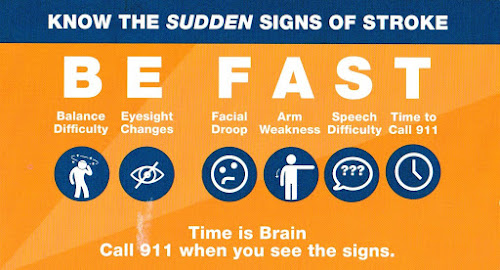
  May is National Stroke Awareness Month A stroke occurs when a blood vessel leading to or in the brain is blocked or ruptures. These blood vessels provide oxygen and nutrients to the brain. "During a stroke, the oxygen and nutrients are unable to reach the brain, therefore the brain cells die. If the brain cells die in a location that regulates a specific body function, there is the possibility that this may hinder that function from working properly. When it comes to strokes, there are three main types: ischemic stroke, hemorrhagic stroke, and transient ischemic attack. An ischemic stroke is when there is a blockage in the blood vessel and can be caused by blood clots, plaque, or other particles. On the other hand, hemorrhagic strokes happen when the blood vessels burst in the brain therefore preventing the blood flow needed to keep the brain alive. The last type is a transient ischemic attack sometimes called a “mini-stroke.” A transient ischemic attack is different from ...

Beyond Burnout

Image
  Beyond Burnout: The Exhausting Reality of Unpaid Family Caregivers (from an article appearing on the AARP website ) ' Already Toast ' author, Kate Washington, on the need for more societal support "Lessons learned During the two long, intense years Washington spent as her husband's primary caregiver and now living with his chronic illness and disability, she has seen her role ebb and flow. When I ask her what she would share with the benefit of hindsight, she offers this advice. Say, ‘Yes!’... Don't delay seeking support...   Get a reality check...   Outsource what you can...   Find a balance between privacy and openness... " read the complete article here Kate Washington  is an essayist and food writer who currently serves as the dining critic for  The Sacramento Bee . Her work has appeared in many publications, including  The Washington Post ,  Eater ,  Catapult , and  McSweeney’s Internet Tendency . She lives in Northern California....

Debts After Death

 originally published by AARP Magazine What Happens to Your Debts After You Die? When loved ones pass away there's way too much to handle in a short time: notifying others despite feelings of intense grief; funeral arrangements; living without the departed individual; keeping or dispensing with their possessions; a potential change in income and other financial matters. And this is a just  partial list . There's also the matter of the debts the person left behind, which raises a flurry of questions. Will they be forgiven somehow? If not, how are they to be paid? What if the liabilities exceed the assets? Who is responsible for them, and under what conditions? Will debt collectors come calling? It's complicated but not insurmountable. ( read the full article ) 1. The estate should cover most bills A person's financial obligations are not automatically forgiven once they've died. According to the Consumer Financial Protection Bureau, in most cases, any unpaid debts ar...

A Great Resource

Image
  Several years ago, while my hubs was going for Out-Pt Physical Therapy one of the other wives recommended an excellent and FREE magazine, Brain & Life , I've found it to be an excellent resource and filled with LOTS of information all about the BRAIN. Did I tell you it is FREE ? You can sign up online at  http://myblsub.com/ This month's edition features articles about Insomnia, Alzheimer's Disease, Parkinsons, Covid-19, nutrition and other neurological disorders. Take a look at the  Top 10 Articles of 2020 . Brain & Life ® is published 6 times per year and mailed free to interested individuals who complete the form below. Brain & Life ® en EspaƱol is published 4 times per year and mailed free with the English edition to interested individuals. an official publication of Back to HOME

8 Ways to Get Your Memory Back After Stroke

Image
  Memory loss after stroke depends on a lot of factors, but games, repetition, exercise, and a brain-boosting diet can help you recover. ( from an article on EveryDay Health ) " Memory loss  is a common  symptom of stroke , but there are things you can do to help get your memory back. Just like exercising your muscles can help improve mobility after a stroke, giving your brain a workout is a significant part of  recovery .  The extent of your memory loss can depend on how old you are, the severity of your stroke, where your stroke occurred, and even the support you have from family and friends. “Memory deficits after a stroke can vary,” says Melissa (Muller) Meyers, an occupational therapist at  MossRehab  in Philadelphia. Memory loss can take the form of  aphasia , suddenly forgetting words and losing the ability to verbally communicate, forgetting stories or conversations, or not being able to recognize formerly familiar faces or routes.......

Glaucoma, a leading cause of blindness

Image
January is Glaucoma Awareness Month:  Don’t Go Blind from Glaucoma Glaucoma is a leading cause of blindness in the world today. More than 80,000 people go blind from glaucoma every year in the U.S., and it is the leading cause of preventable blindness in African-Americans and people from the Caribbean. Cataracts are the most identifiable cause of glaucoma.  New York City glaucoma specialist Dr. Daniel Laroche wants to remind all of us that protecting our eye health is imperative for our overall quality of life, particularly for those in high-risk groups and those with chronic ocular conditions. Dr. Laroche is also a passionate advocate for eliminating barriers to health care that exist for Black and Brown people.  It’s the new year and one of your resolutions should be to get your eyes checked, advises Dr. Daniel Laroche, Director of Glaucoma Services and President of Advanced Eyecare of New York. Despite the busyness of the new year, he says it’s still important to ...

Legal Documents for Caregivers

Image
Legal Documents Caregivers Must Have " A Durable POA (Power of Attorney) provides the legal permissions necessary for someone else to pay household bills, living expenses, taxes, investments, purchases, and other financial tasks " when they are unable to do it for themselves. ( FinancialHealth.net ) The article seems to be written for pre-planning for the individual who MAY need the assistance or for when the assistance is actually required and before a person may not have the mental capacity for making the choice (hence why it is DURABLE). A regular Power-of-Attorney will CANCEL if and when the principal becomes mentally incapacitated and cannot make their own decisions. Since MANY married couples already share property and bank accounts, there may be no need to designate a Durable Financial Power of Attorney on the chance of mental incapacitation unless there is property/accounts held in one name only; some states also restrict the complete sale of jointly ow...

Reposting: About Medicaid & Assets

Image
Can Medicaid Really Seize Your Assets? (FinancialHealth.net) – Advances in medicine means people are living longer, but it’s also leading to the need for long term care. Even the best insurance only covers limited hospitalization and recovery periods. A major health event requiring long term care can trigger a series of events that can wipe a person out financially. To protect assets from seizure in the event that long term care is needed, estate planning must be done at least 5 years in advance. Why 5 years?  Medicare  and other related supplemental policies have limited coverage for short-term skilled nursing needs, but those programs don’t pay for long term care. The majority of long term care falls onto the shoulders of state Medicaid programs, for those who qualify for Medicaid and Medicare.  Medicaid  has a five-year lookback period when it comes to assets. READ MORE ...   FinancialHealth.net Back to HOME

Rewiring the Brain (from NeroRehabDirectory.com)

Image
Scientists once believed that the brain stopped developing after the first few years of life. They thought that connections formed between the brain’s nerve cells during an early “critical period” and then were permanent as we age. Scientists also thought that if a particular area of the adult brain was damaged, the nerve cells could not form new connections, and the functions controlled by that area of the brain would be lost... Read more on NeuroRehabDirectory.com Back to HOME

Think You're Too Young for a Stroke?

Image
Think You're Too Young for a Stroke? Think Again ( An Informative Article from Every Day Health ) Find out about the causes of stroke in people younger than 45, and how to prevent it. For most young people, the chance of having a  stroke  seems like an impossibility — but there is no such thing as being too young for stroke. Your stroke risk increases with age, but stroke in young people, including infants, children, adolescents, and young adults, does happen. In general, however, most experts consider a young stroke age to be under 45. (... READ MORE ) Back to Home

Helpful YouTube Videos

Image
Stroke Survivor's Guide to Getting Things Done I was recently made aware of a wonderful series of videos made by an actual Stroke Survivor (& filmed by his wife). Paul had a stroke in May 2017 and has worked very hard at "recovery", but he has been left with deficits which he continues to work hard at overcoming.  Paul's videos show in wonderful detail just how he is managing to do the "normal" things that many of us take for granted and he does so in a way that is both encouraging and instructive for other Stroke Survivors and their support systems. No Stroke Survivor is the same, but watching a real life Survivor mastering everyday life is inspirational for all of us going through this journey. I highly recommend subscribing to Paul's channel,  The Stroke Survivor's Guide to Getting Things Done . https://www.youtube.com/channel/UCCo6Ji-wjeNiF6nKYsuw7EQ ( he continues to add new videos so check back regularly ) ...

A-FIB and the risk for Stroke

Image
Atrial fibrillation  ( AF  or  A-fib ) is an  abnormal heart rhythm  characterized by  rapid and irregular beating  of the  atria .  Often it starts as brief periods of abnormal  beating  which become longer and possibly constant over time.  Often episodes have no symptoms.  Occasionally there may be heart  palpitations ,  fainting ,  lightheadedness ,  shortness of breath , or  chest pain .  The disease is associated with an increased risk of  heart failure ,  dementia , and  stroke .  It is a type of  supraventricular tachycardia .   ( from Wikipedia ) See AFibAre you at risk?   AFib is linked with a 5x higher risk of stroke. Take a quiz from the American Heart Association Visit heart.org/AFibTools to learn more  about AFib symptoms and stroke risk.  Back to Home

Disability Services & Waivers ~ all 50 U.S. states

Image
" Medicaid Waivers help provide services to people who would otherwise be in a nursing home or hospital to receive long-term care in the community. Although there are waivers for many conditions, our focus is towards waivers for people who have intellectual disabilities, developmental disabilities, and autism. " ( http://medicaidwaiver.org/index.html ) SEE ELDERLY / SENIOR CARE WAIVERS " Many people who qualify for waiver services are not even aware that they exist. Families struggle alone, to provide care- creating economic, physical, and emotional strain. States do not educate people about these programs, and it is often only through crisis that people realize help is available. "  ( http://medicaidwaiver.org/index.html ) Find YOUR State for Available Resources Back to Home

3 Informational Videos About the Brain

Image
3 clues to understanding your brain Vilayanur Ramachandran tells us what brain damage can reveal  about the connection between celebral tissue and the mind, using three startling delusions as examples. for more info ⇋ A look inside the brain in real time Neuroscientist and inventor Christopher deCharms demonstrates a new way to use fMRI to show brain activity -- thoughts, emotions, pain -- while it is happening. In other words, you can actually see how you feel. for more info ⇋ My stroke of insight Jill Bolte Taylor got a research opportunity few brain scientists would wish for: She had a massive stroke, and watched as her brain functions -- motion, speech, self-awareness -- shut down one by one. An astonishing story. for more info Back to Home