Posts

Showing posts with the label stroke

May 2021 ~ Stroke Awareness Month
Image
  May is National Stroke Awareness Month A stroke occurs when a blood vessel leading to or in the brain is blocked or ruptures. These blood vessels provide oxygen and nutrients to the brain. "During a stroke, the oxygen and nutrients are unable to reach the brain, therefore the brain cells die. If the brain cells die in a location that regulates a specific body function, there is the possibility that this may hinder that function from working properly. When it comes to strokes, there are three main types: ischemic stroke, hemorrhagic stroke, and transient ischemic attack. An ischemic stroke is when there is a blockage in the blood vessel and can be caused by blood clots, plaque, or other particles. On the other hand, hemorrhagic strokes happen when the blood vessels burst in the brain therefore preventing the blood flow needed to keep the brain alive. The last type is a transient ischemic attack sometimes called a “mini-stroke.” A transient ischemic attack is different from ...

8 Ways to Get Your Memory Back After Stroke

Image
  Memory loss after stroke depends on a lot of factors, but games, repetition, exercise, and a brain-boosting diet can help you recover. ( from an article on EveryDay Health ) " Memory loss  is a common  symptom of stroke , but there are things you can do to help get your memory back. Just like exercising your muscles can help improve mobility after a stroke, giving your brain a workout is a significant part of  recovery .  The extent of your memory loss can depend on how old you are, the severity of your stroke, where your stroke occurred, and even the support you have from family and friends. “Memory deficits after a stroke can vary,” says Melissa (Muller) Meyers, an occupational therapist at  MossRehab  in Philadelphia. Memory loss can take the form of  aphasia , suddenly forgetting words and losing the ability to verbally communicate, forgetting stories or conversations, or not being able to recognize formerly familiar faces or routes.......

Think You're Too Young for a Stroke?

Image
Think You're Too Young for a Stroke? Think Again ( An Informative Article from Every Day Health ) Find out about the causes of stroke in people younger than 45, and how to prevent it. For most young people, the chance of having a  stroke  seems like an impossibility — but there is no such thing as being too young for stroke. Your stroke risk increases with age, but stroke in young people, including infants, children, adolescents, and young adults, does happen. In general, however, most experts consider a young stroke age to be under 45. (... READ MORE ) Back to Home

A-FIB and the risk for Stroke

Image
Atrial fibrillation  ( AF  or  A-fib ) is an  abnormal heart rhythm  characterized by  rapid and irregular beating  of the  atria .  Often it starts as brief periods of abnormal  beating  which become longer and possibly constant over time.  Often episodes have no symptoms.  Occasionally there may be heart  palpitations ,  fainting ,  lightheadedness ,  shortness of breath , or  chest pain .  The disease is associated with an increased risk of  heart failure ,  dementia , and  stroke .  It is a type of  supraventricular tachycardia .   ( from Wikipedia ) See AFibAre you at risk?   AFib is linked with a 5x higher risk of stroke. Take a quiz from the American Heart Association Visit heart.org/AFibTools to learn more  about AFib symptoms and stroke risk.  Back to Home

May is National Stroke Awareness Month

Image
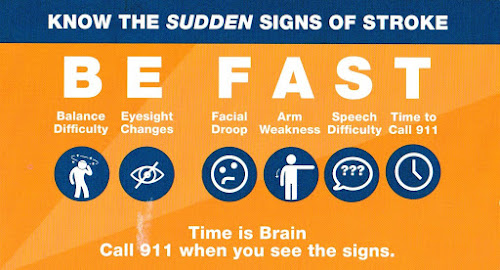
Think F.A.S.T. FACE : Ask the person to smile. Does one side of the face droop? ARMS : Ask the person to raise both arms. Does one arm drift downward? SPEECH : Ask the person to repeat a simple phrase. Is their speech slurred or strange? TIME : If you observe any of these signs, call 9-1-1 immediately. Think F.A.S.T. FACE: Ask the person to smile. Does one side of the face droop? ARMS: Ask the person to raise both arms. Does one arm drift downward? SPEECH: Ask the person to repeat a simple phrase. Is their speech slurred or strange? TIME: If you observe any of these signs, call 9-1-1 immediately. Think F.A.S.T. FACE: Ask the person to smile. Does one side of the face droop? ARMS: Ask the person to raise both arms. Does one arm drift downward? SPEECH: Ask the person to repeat a simple phrase. Is their speech slurred or strange? TIME: If you observe any of these signs, call 9-1-1 immediately. ...

Flashbacks

Image
As the wife of a stroke survivor I've found I have a reaction inside my gut every time I hear of someone having a stroke... actually I am both the wife of a survivor AND the daughter of a woman who died several months after having a massive stroke. The word STROKE itself makes me feel a sharp pain as I dig my fingernails into my palms. According to WebMD, Post Traumatic Stress Disorder (PTSD)  describes many people who experience or witness severe trauma (such as the death or illness of a loved one) and who relive the ordeal through memories, flashbacks and nightmare; they develop problems dealing with others, expressing themselves, and may have symptoms that keep them from functioning in a "normal" life. For people who experience a traumatic event these reactions are normal, but most people outgrow them in time. People who don't outgrow these crippling reactions, who are diagnosed with PTSD, often need help to find ways to cope. " Treatment for PTSD  may inv...

Helpful information about memory loss

Image
Memory Problems Can be Caused by Stroke Suffering a stroke can impair a person’s memory for weeks, months, or even years. Sometimes, a person evaluated for memory loss is found to have suffered minor strokes they weren’t even aware of, says Mohini Gurme, MD, a neurologist with Rockland Neurological Associates in West Nyack, NY. For Stroke Awareness Month, in May, Dr. Gurme explains why it’s important to get evaluated early for memory loss caused by stroke or other conditions... to continue reading Back to HOME

About Post-Stroke Emotions

Image
Extreme mood swings, it is a thing... There is a lot going on in a stroke survivor's mind after a stroke and sometimes the emotional ups-and-downs winds up becoming frustrating and very difficult to cope with for the people around him/her. This is just a personal observation (my mom had a stroke in 1978 and my husband had a stroke in 2016) but from what I hear from other caregivers and my own experience I think women tend to have more emotions and men more anger. As I said I don't have proof of this... I am aware that most men, even in this era, are still raised to be the "strong provider" and suddenly they are dependent on someone else, they often can't go back to work, and they can't even play catch with the family dog. It's frustrating as hell for them and they express their frustration with attitude; so often the target of their angry words is the one person most responsible for them, the wife (or significant other). And no matter how much we un...

National Stroke Awareness Month 2018

Image
National Stroke Awareness Month is an annual event held within the United States. The aim of National Stroke Awareness Month is to make Americans aware that they may be able to ' Save A Life ' of a person experiencing a stroke. Read More... Summary Coverage United States Month May Duration 1 Month Date May 2018 Organization National Stroke Association How Is Date Set?  Fixed: Same Month Each Year Event Page/Website Back to HOME

Take care of yourself - support groups

Image
I road as a (volunteer) N.Y.S. Emergency Medical Technician for nearly 30-years. I dealt with all kinds of emergencies, all ages, and a variety of outcomes (both good and bad). I would have thought I would be fully "professional" when it came to my own husband's stroke... Instead I barely held it together. I was fortunate that I was able to lean on our daughter, son and daughter-in-law (all with EMS experience themselves, but they too were filled with emotions). We were all so fortunate that despite what seemed so frightening that first night, my husband did survive and, just like he has been for the better part of his life, he was determined NOT to be beaten. The two months that he was hospitalized are still a bit of a blur. I remember doing most of the things I had to do like housekeeping, grocery shopping, paying bills and the small amount of work I HAD to get done (thankfully I had understanding editors and a compassionate publisher). And at least six days a week ...

What is a Stroke?

Image
What is a Stroke? Blood Flow Blocked in the Brain courtesy of American Heart Association A person can suffer a stroke when blood flow and oxygen are cut-off, cells can die and depending on the area, time and amount of the brain affected will determine the extent of disability. A STROKE is a life-or-death situation and  needs  immediate  medical attention .  Call 911! Common terms to know : Ischemic Stroke  ~ The arteries to the brain become blocked and/or narrowed cutting off blood flow. Hemorrhagic Stroke  ~ The arteries to the brain can rupture and bleed. Transient Ischemic Attack (TIA)  ~ This is a TEMPORARY interruption of blood flow to the brain. Common Signs & Symptoms CAN include : ***Sudden numbness to the extremities, often affecting one side of the body. ***Sudden confusion and difficulty speaking. ***Difficulty walking and/or staying balanced. ***Sudden severe headache. F.A.S.T.   F ACE , Ask the person to ...